

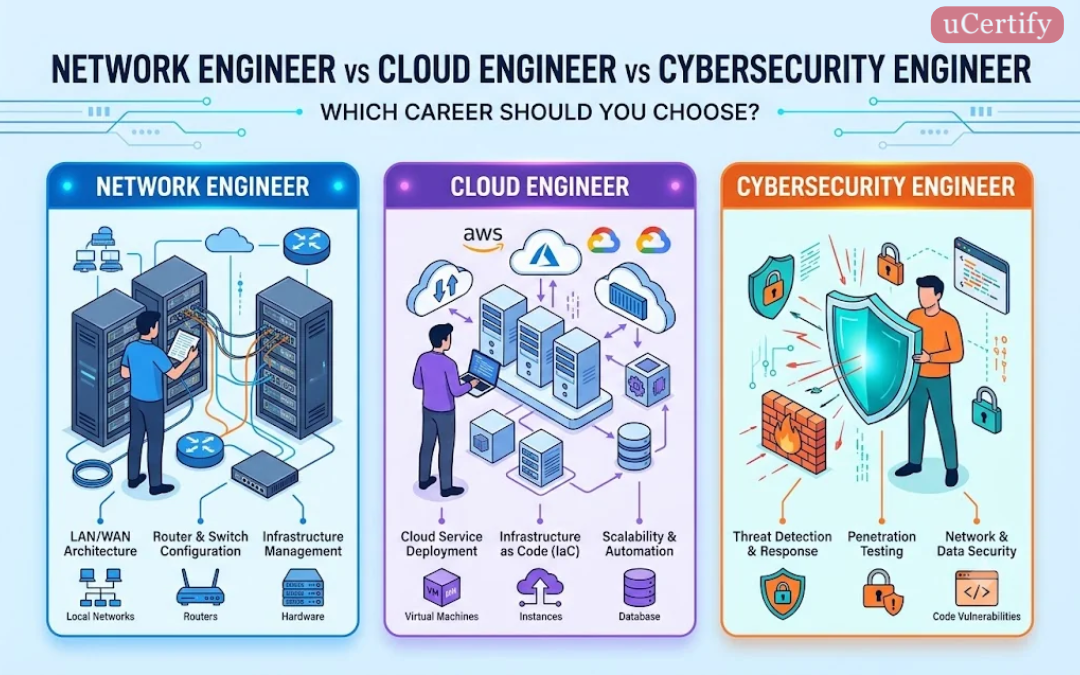
Imagine that an online learning platform suddenly becomes slow during examination week. Students struggle to open lessons, some instructors cannot access shared resources, and the IT team notices repeated login attempts against employee accounts. Three technical specialists may be involved in resolving the problem: a network engineer, a cloud engineer, and a cybersecurity engineer.
They are not doing the same job. One investigates how data travels between systems, another checks the infrastructure supporting the application, and the third examines whether suspicious activity threatens the platform. Their work overlaps, but each brings a different set of skills to the problem.
This is why choosing between these careers requires more than comparing job titles or salary estimates. You need to understand what each professional actually does, what employers expect, and which technical problems you would enjoy solving.
In this guide, we will compare Network Engineer vs Cloud Engineer vs Cybersecurity Engineer across responsibilities, technical skills, tools, certifications, career opportunities, and beginner learning paths. By the end, you should be able to identify the career that best matches your interests and choose a practical first project to test that decision.
What Is the Difference Between a Network Engineer, Cloud Engineer, and Cybersecurity Engineer?
The easiest way to understand these careers is to look at the problem each one is primarily responsible for solving.
A network engineer makes sure devices, applications, and systems can communicate reliably. A cloud engineer builds and maintains the computing infrastructure on which applications and services run. A cybersecurity engineer designs and implements technical controls that reduce the risk of unauthorized access, attacks, and data exposure.
These responsibilities are connected. A cloud application depends on network connectivity, and both its infrastructure and its traffic need appropriate security controls. In a real organization, the three engineers may work together rather than solve problems independently.
Network Engineer vs Cloud Engineer vs Cybersecurity Engineer: Quick Comparison
| Comparison factor | Network Engineer | Cloud Engineer | Cybersecurity Engineer |
| Main responsibility | Reliable network communication | Reliable cloud infrastructure | Protection of systems and data |
| Typical problem | Devices or applications cannot communicate | Applications are slow, unavailable, or poorly provisioned | Systems have vulnerabilities or suspicious activity |
| Core knowledge | TCP/IP, routing, switching, subnetting | Cloud services, networking, automation | Security controls, access management, threat analysis |
| Common tools | Wireshark, Cisco IOS, network monitoring tools | AWS, Microsoft Azure, Google Cloud, Terraform | SIEM platforms, vulnerability scanners, endpoint security tools |
| Example output | A working, documented network configuration | A deployed and monitored cloud environment | A hardened system with documented security controls |
| Useful beginner project | Design and troubleshoot a routed network | Deploy a small application and monitor it | Secure a test machine and investigate its logs |
| Possible career progression | Senior Network Engineer, Network Architect | Senior Cloud Engineer, Cloud Architect | Senior Security Engineer, Security Architect |
The table describes common responsibilities, not strict boundaries. A network engineer may configure firewalls, a cloud engineer may manage security permissions, and a cybersecurity engineer may analyze network traffic. The difference lies in the primary purpose of the work.
1. Network Engineer: Keeping Systems Connected
A network engineer designs, configures, maintains, and troubleshoots the infrastructure that allows devices and applications to exchange data. Depending on the employer, this may include office networks, wireless systems, data centers, wide area networks, and connections between on-premises infrastructure and cloud platforms.
The work often begins when something stops behaving as expected. Employees may lose access to an application, a wireless connection may become unreliable, or a server may be reachable from one department but not another.
The engineer’s task is to find the cause, restore service, and reduce the likelihood of the same issue happening again.
What Does a Network Engineer Do?
Typical responsibilities include:
- Configuring routers, switches, wireless access points, and network firewalls.
- Planning IP addressing, subnetting, VLANs, and routing.
- Troubleshooting DNS, DHCP, packet loss, latency, and connectivity failures.
- Monitoring network availability and performance.
- Maintaining secure connections between offices, data centers, and cloud environments.
- Documenting network diagrams, configurations, and troubleshooting procedures.
- Improving resilience through redundancy and appropriate network design.
Some of these tasks are straightforward; others require tracing a problem through several layers of the network.
A Practical Example: Diagnosing a Connectivity Failure
Suppose employees on one floor of an office can access a shared application, but employees on another floor cannot.
A network engineer would not necessarily begin by replacing a switch or restarting every device. A more disciplined investigation might look like this:
- Check the scope. Determine whether the issue affects one device, one subnet, or an entire department.
- Verify IP configuration. Check the device’s IP address, subnet mask, default gateway, and DNS settings.
- Test connectivity. Use tools such as ping and traceroute or tracert, recognizing that firewalls may block some diagnostic traffic.
- Inspect the network path. Review VLAN assignments, routing tables, and relevant firewall rules.
- Confirm the fix. Repeat the failed test, verify application access, and document the root cause.
Imagine that the affected devices were assigned to the wrong VLAN and could not reach the intended gateway. Correcting that configuration may restore access. The important lesson is that good troubleshooting follows evidence rather than guesswork.
Skills and Tools for Network Engineers
Networking fundamentals are the starting point. You should understand the OSI and TCP/IP models, IPv4 and IPv6 addressing, subnetting, routing, switching, DNS, and DHCP.
Practical tools help turn that knowledge into a usable skill. Cisco Packet Tracer can be used to build simulated networks, while Wireshark helps inspect captured packets. Command-line tools such as ping, traceroute, ipconfig, and ip are useful for examining connectivity and configuration.
As your experience grows, you may move into network automation, software-defined networking, wireless design, hybrid cloud connectivity, or advanced network security.
Certifications to Consider
CompTIA Network+ is one option for learning broad networking concepts, infrastructure, operations, and troubleshooting. Cisco CCNA is another well-known option that develops networking knowledge, including IP connectivity, network access, and security fundamentals. Experienced professionals may consider Cisco CCNP Enterprise for more advanced enterprise networking study.
A certification can structure your learning, but it does not replace hands-on troubleshooting. Before applying for a role, practise configuring a network, diagnosing a fault, and explaining the steps you took to resolve it.
Who Should Choose Network Engineering?
Network engineering is worth exploring if you like tracing problems to their source, understanding how systems communicate, and working through technical details in a logical sequence.
You may particularly enjoy it if solving a connectivity problem feels more satisfying than simply finding a workaround. Networking also provides useful foundational knowledge for cloud engineering and cybersecurity.
2. Cloud Engineer: Building and Managing Cloud Infrastructure
Cloud engineering focuses on the computing resources and services that support applications. Instead of relying exclusively on physical servers maintained at an organization’s own premises, a business can provision resources from platforms such as Amazon Web Services (AWS), Microsoft Azure, and Google Cloud.
Cloud engineers help design, deploy, manage, and improve these environments. Their work may involve virtual machines, storage, cloud networking, identity permissions, automation, monitoring, backups, and reliability.
The role is not simply about creating servers online. A cloud environment must be secure, available when needed, properly configured, and cost-effective.
What Does a Cloud Engineer Do?
Common responsibilities include:
- Provisioning computing, storage, networking, and other cloud resources.
- Configuring virtual networks, routing, and access permissions.
- Automating infrastructure deployment and routine operations.
- Monitoring application availability, resource consumption, and performance.
- Supporting migration from on-premises systems to cloud environments.
- Implementing backup, recovery, and disaster-recovery procedures.
- Reviewing resource usage and controlling unnecessary cloud spending.
- Working with developers, network teams, and security professionals.
The precise responsibilities depend on the employer. Some cloud engineers focus on infrastructure operations, while others work more heavily with automation, containers, reliability, or platform engineering.
A Practical Example: Preparing for a Traffic Spike
Consider an educational website that normally serves a few thousand learners but receives much heavier traffic during examination week.
Simply purchasing a more powerful server may not be the best answer. The cloud engineer needs to understand where the bottleneck occurs and whether the environment can respond to changing demand.
A sensible investigation could include:
- Reviewing application metrics, CPU usage, memory consumption, and response times.
- Checking whether the database, application servers, network, or another component is the main bottleneck.
- Evaluating whether the architecture supports scaling and whether the relevant cloud services are configured correctly.
- Testing performance under controlled load before changing production infrastructure.
- Configuring monitoring, suitable scaling policies, backups, and budget alerts.
For example, an application hosted on virtual machines might use an auto-scaling configuration to add capacity as demand rises. However, scaling the application servers will not solve every problem. If the database has reached its connection limit, that bottleneck must be addressed separately.
This is one of the most useful lessons in cloud engineering: adding resources is not the same as solving the underlying design problem.
Skills and Tools for Cloud Engineers
A cloud engineer benefits from understanding networking, operating systems, virtualization, storage, and basic scripting.
Important skills include:
- Cloud compute, storage, and networking services.
- Linux and Windows administration.
- Identity and Access Management (IAM), which controls who can access which resources.
- Scripting with Python, Bash, or PowerShell.
- Infrastructure as Code (IaC), which allows infrastructure configurations to be defined and managed through files rather than repeated manual setup.
- Monitoring, logging, backup, and recovery.
- Containers and orchestration when required by the target role.
Terraform is one example of an Infrastructure as Code tool. Rather than configuring every resource manually, an engineer can define the desired infrastructure and use a repeatable workflow to manage it.
Cloud engineers must also understand cost and security. A resource that is technically functional may still be poorly designed if it exposes sensitive data or continues running unnecessarily.
Certifications to Consider
Potential options include:
- AWS Certified Solutions Architect – Associate: Focuses on designing solutions using AWS services.
- Microsoft Certified: Azure Administrator Associate: Covers important Azure administration and infrastructure-management skills.
- Google Cloud Associate Cloud Engineer: Focuses on deploying and managing solutions in Google Cloud.
Check the official certification pages for current requirements, exam objectives, and availability before beginning your preparation.
Who Should Choose Cloud Engineering?
Cloud engineering may suit you if you like building systems, automating repetitive work, and understanding how applications operate under different conditions.
You may enjoy the role if you want to combine networking, operating systems, infrastructure, and scripting rather than concentrating on just one technical area.
A good test is to deploy a small application, configure its permissions, monitor its performance, and estimate its running costs. If you find yourself wanting to improve the design after the first deployment, cloud engineering may be worth exploring further.
3. Cybersecurity Engineer: Designing Defenses Against Digital Threats
Cybersecurity engineers help protect systems, applications, networks, and information against unauthorized access and other security risks. They design and implement technical controls, investigate weaknesses, and work to reduce the likelihood and impact of security incidents.
The job is broader than catching attackers. A large part of defensive security involves preventing avoidable problems through appropriate access permissions, secure configurations, patching, monitoring, and well-tested response procedures.
Some cybersecurity engineers focus on infrastructure and security architecture. Others concentrate on cloud security, endpoint protection, identity systems, or security automation.
What Does a Cybersecurity Engineer Do?
Typical responsibilities include:
- Implementing security controls for networks, servers, applications, and endpoints.
- Managing access permissions and applying the principle of least privilege.
- Identifying vulnerabilities and supporting their remediation.
- Configuring endpoint protection, firewalls, and security monitoring.
- Reviewing logs and investigating suspicious activity.
- Supporting incident response and recovery.
- Implementing encryption and appropriate authentication controls.
- Helping teams apply security policies and relevant compliance requirements.
Security engineering involves trade-offs. A control must reduce risk without unnecessarily preventing legitimate work. For example, strict access restrictions may improve protection, but poorly planned restrictions can interrupt important business processes.
A Practical Example: Investigating Suspicious Login Activity
Suppose a company’s security monitoring platform reports repeated failed logins against several employee accounts, followed by a successful login from an unusual location.
A cybersecurity engineer might approach the alert in stages:
- Validate the alert. Examine timestamps, affected accounts, source information, and authentication records.
- Assess the risk. Determine whether the successful login is unusual for the account and whether other suspicious activity occurred.
- Contain the exposure where necessary. Coordinate appropriate account restrictions, session revocation, or credential resets according to incident procedures.
- Investigate the cause. Review relevant logs and identify whether credentials, authentication controls, or another weakness contributed to the incident.
- Strengthen defenses. Consider stronger authentication, improved access policies, alert tuning, and other controls supported by the findings.
A single unusual login does not automatically prove that an account has been compromised. Context matters. The engineer needs to evaluate the evidence and respond proportionately.
This example also illustrates the difference between monitoring and engineering. A Security Operations Center (SOC) analyst may detect and initially investigate an alert, while a cybersecurity engineer may help design the controls, improve detections, and implement technical changes that reduce future risk. In some organizations, these duties overlap.
Skills and Tools for Cybersecurity Engineers
A useful starting point includes networking, operating systems, identity management, security principles, and basic scripting.
Key areas to learn include:
- Network protocols and traffic analysis.
- Linux and Windows security.
- Authentication, authorization, and access control.
- Vulnerability assessment and remediation.
- System hardening and endpoint protection.
- Security monitoring and incident-response fundamentals.
- Encryption, threat modeling, and security architecture.
- Cloud security for roles involving cloud infrastructure.
A SIEM, or Security Information and Event Management platform, collects and helps analyze security-related events from multiple sources. Vulnerability scanners help identify known weaknesses, while endpoint protection tools monitor or defend individual devices.
Learners should practise these skills only in systems they own or are explicitly authorized to test. A controlled virtual lab is a suitable environment for experimenting with security configurations and reviewing logs.
Certifications to Consider
CompTIA Security+ is one possible foundational security certification. Professionals developing broader security expertise may later consider advanced credentials such as the Certified Information Systems Security Professional (CISSP), subject to its experience and endorsement requirements.
Cisco also offers security-focused certification paths; review its current certification portfolio to identify the credential that best matches your goals.
Certifications can help organize study, but security engineering also demands judgment. Knowing that a vulnerability exists is only part of the task; an engineer must understand its exposure, prioritize remediation, and verify that the change reduces risk.
Who Should Choose Cybersecurity Engineering?
Cybersecurity engineering may be a strong option if you enjoy investigating unusual behavior, understanding how systems fail, and building defenses against possible attacks.
It is especially worth exploring if you like asking questions such as: What could go wrong? How would we detect it? What evidence would confirm the problem? How can we reduce the risk without disrupting legitimate users?
4. One Real-World Problem, Three Engineering Perspectives
The clearest way to understand the overlap between these careers is to look at a single technical incident.
Imagine that an online learning platform becomes slow, some users cannot access course resources, and the security team reports unusual account activity.
The teams should not assume that every symptom has the same cause. They need to establish what is happening, collect evidence, and coordinate their response.
How the Three Engineers Work Together
The network engineer investigates communication. The engineer checks connectivity, routing, packet loss, DNS resolution, and network-device performance. The goal is to determine whether traffic can reach the required destination and whether the network is contributing to the delay.
The cloud engineer investigates infrastructure. The engineer examines application metrics, server capacity, cloud networking, resource limits, and recent deployments. If a database or application component is overloaded, the cloud engineer works to identify and address that bottleneck.
The cybersecurity engineer investigates suspicious activity. The engineer reviews authentication events, access policies, and relevant security alerts. If the evidence indicates a compromised account, the engineer coordinates containment and recommends changes to reduce the risk of recurrence.
The three teams then share findings. A slow application might be caused by resource exhaustion rather than a network failure. A legitimate performance issue might also coincide with a separate account-security incident.
The lesson is important for anyone choosing an IT career: technical problems rarely respect job-title boundaries. Strong specialists understand their own area, recognize when evidence points elsewhere, and communicate effectively with other teams.
5. Skills Comparison: What Should You Learn First?
All three careers require troubleshooting, an understanding of operating systems, and a working knowledge of networks. The difference is the depth and direction of specialization.
| Skill area | Network Engineer | Cloud Engineer | Cybersecurity Engineer |
| Networking | Deep understanding of routing, switching, and connectivity | Cloud networking and service connectivity | Network behavior, traffic analysis, and defensive controls |
| Operating systems | Administration and network services | Administration, workloads, and automation | Hardening, logs, access, and system security |
| Scripting | Useful for monitoring and automation | Frequently useful for repeatable infrastructure management | Useful for investigation and security automation |
| Cloud platforms | Useful for hybrid networking | Central to the role | Important for cloud-security responsibilities |
| Security | Network access controls and segmentation | IAM, configuration, and secure operations | Primary specialization |
| Troubleshooting | Diagnosing communication failures | Finding infrastructure and service bottlenecks | Investigating weaknesses, alerts, and suspicious behavior |
| Typical deliverable | A reliable, documented network | A working, monitored cloud environment | Implemented security controls and documented risk reduction |
The table should not be read as a list of skills that belong exclusively to one role. Cloud engineers need security awareness, cybersecurity engineers need to understand networks, and network engineers must consider security when designing infrastructure.
Which Skills Transfer Between Careers?
A network engineer moving into cloud engineering can build on knowledge of routing, subnets, DNS, and connectivity. The next step is learning cloud services, infrastructure provisioning, and automation.
A network engineer moving into cybersecurity can apply traffic analysis and firewall knowledge to defensive monitoring, segmentation, and access control. Additional study in operating-system security, vulnerability management, and incident response will be necessary.
A cloud engineer moving into cloud security can build on IAM, networking, monitoring, and infrastructure configuration. The new focus is to understand threats, evaluate exposure, and design controls appropriate to the environment.
These transitions are realistic, but they are not automatic. Experience in one specialization creates a foundation; it does not replace the skills required in another.
6. Salary and Career Opportunities: What Should You Compare?
There is no universal salary winner among network engineering, cloud engineering, and cybersecurity engineering. Compensation varies with location, experience, employer, industry, specialization, and job scope.
Comparing a junior network engineer with a senior cloud architect would not provide a fair picture. A meaningful comparison uses similar experience levels and locations and distinguishes engineering positions from management or architecture roles.
What Can Influence Career Growth?
Network engineering: Experience in enterprise networking, complex troubleshooting, automation, network architecture, and hybrid cloud connectivity can support progression toward senior engineering and architecture roles.
Cloud engineering: Expertise in infrastructure automation, cloud architecture, reliability, migration, and cost optimization can create opportunities for more specialized roles.
Cybersecurity engineering: Experience with security architecture, cloud security, identity controls, detection engineering, and incident response can support progression into senior or specialized security positions.
Job titles alone do not reveal the whole opportunity. One employer may advertise a cloud engineer role that mainly involves administration, while another expects substantial automation and architecture skills.
How to Research Salaries Properly
If salary is a deciding factor, use current data for your intended job market.
- Choose a location and currency.
- Compare roles at a similar experience level.
- Check whether reported figures represent base pay, total compensation, or an estimated range.
- Review multiple reputable sources and current job advertisements.
- Compare the skills required, not just the salary figures.
Do not assume that every cybersecurity role pays more than every networking role or that cloud engineering automatically guarantees higher earnings. Your experience and the type of work you can perform are important factors.
7. Which Career Is Best for Beginners?
The best starting point depends on what you want to learn and the experience you already have.
If you are completely new to IT, begin with computer systems, operating systems, networking fundamentals, and troubleshooting. These subjects help you understand the infrastructure that all three specializations rely on.
You do not have to become a network engineer before pursuing cloud engineering or cybersecurity. However, basic networking knowledge will make both fields easier to understand.
Use your preferred way of solving problems to guide the next step:
- Choose network engineering if you want to understand connectivity, diagnose routing issues, and configure network infrastructure.
- Choose cloud engineering if you enjoy building environments, deploying services, and automating infrastructure.
- Choose cybersecurity engineering if you want to investigate weaknesses, evaluate threats, and implement protective controls.
A Six-Step Learning Roadmap
Step 1: Learn the fundamentals. Study IP addressing, DNS, operating systems, basic networking, and command-line troubleshooting.
Step 2: Select one primary direction. Choose networking, cloud infrastructure, or defensive security rather than trying to learn every tool at once.
Step 3: Set up a suitable lab. Use a network simulator, a local virtual machine, or a cloud environment. Check service limits and potential charges before deploying cloud resources.
Step 4: Complete a practical project. Build something that can be tested, documented, and explained to another person.
Step 5: Study for a relevant certification. Use the official exam objectives to structure your learning. Treat the credential as supporting evidence, not a substitute for practical ability.
Step 6: Create a project portfolio. Document the original problem, your approach, the tools used, the outcome, and what you would improve next time.
8. Three Beginner Projects That Test Your Career Choice
Before investing months in certification preparation, complete a small project in your preferred area. You will learn more about day-to-day work by solving a real problem than by reading job descriptions alone.
Project 1: Network Troubleshooting Lab
Objective: Build and troubleshoot a small network.
Tools: Cisco Packet Tracer or another suitable network simulator.
Tasks:
- Create two subnets and configure the necessary routing.
- Test communication between devices.
- Introduce a controlled configuration error.
- Identify and correct the problem.
- Record the commands, test results, and root cause.
Successful outcome: Devices that should communicate can do so, and your documentation explains how you identified the failure.
Project 2: Cloud Application Deployment
Objective: Deploy and monitor a simple application.
Tools: One cloud provider, a basic application, and the provider’s monitoring services.
Tasks:
- Provision the required compute and network resources.
- Configure access permissions.
- Deploy the application and verify that it works.
- Review resource utilization and configure suitable monitoring.
- Document how you would back up or recover the service.
Successful outcome: The application works as intended, permissions are appropriate, and you can explain the infrastructure and its operational costs.
Use budget alerts and remove resources you no longer need. A cloud project can incur charges even when it is intended only for learning.
Project 3: Defensive Security Lab
Objective: Harden a test machine and investigate security-related events.
Tools: An isolated virtual machine, operating-system security settings, and available system logs.
Tasks:
- Apply appropriate updates and security configurations.
- Review accounts, permissions, and enabled services.
- Generate benign test events or inspect existing logs.
- Identify unusual or unnecessary access.
- Document the weakness, corrective action, and verification method.
Successful outcome: You can explain the security changes you made, show how you verified them, and identify remaining limitations.
Keep the lab isolated and work only on systems you own or have permission to assess.
9. Can You Move from One Career to Another?
Yes. The three careers share enough foundational knowledge to make career changes possible, although the transition requires focused learning.
A network engineer moving to cloud engineering should add cloud provisioning, IAM, infrastructure automation, and monitoring. Someone moving from networking into cybersecurity should develop security analysis, operating-system hardening, vulnerability management, and incident-response skills.
A cloud engineer moving into cybersecurity can build on cloud networking and identity controls, then study threat modeling, security monitoring, and defensive architecture.
The most useful transition plan begins with a skills-gap analysis. Review job advertisements for the role you want, list the skills you already possess, and identify the two or three most important gaps. Build projects that demonstrate those skills before investing in advanced credentials.
Conclusion: Which IT Career Should You Choose?
Network engineering, cloud engineering, and cybersecurity engineering solve different problems, even though they often work together.
A network engineer focuses on reliable communication. A cloud engineer builds and maintains the infrastructure that supports applications. A cybersecurity engineer designs and implements controls that protect systems and data.
If you are unsure which direction to choose, do not rely only on job titles, salary claims, or certification popularity. Start with a small practical project in the area that interests you most. The work itself will help you discover whether you enjoy network troubleshooting, cloud infrastructure, or security investigation.
The strongest starting point is a combination of solid fundamentals, hands-on practice, and a clear understanding of the job you want. You can specialize further as your skills and interests develop.
Frequently Asked Questions
1. Which is better: a network engineer, cloud engineer, or cybersecurity engineer?
None is universally better. Network engineering suits people interested in connectivity and troubleshooting, cloud engineering suits people interested in infrastructure and automation, and cybersecurity engineering suits people interested in implementing security controls and reducing risk.
2. Can I become a cloud engineer without first working as a network engineer?
Yes. You can study cloud engineering directly while learning networking fundamentals. Understanding IP addressing, routing, DNS, and subnets will help you configure and troubleshoot cloud environments.
3. Is cybersecurity engineering suitable for beginners?
It can be, but some engineering positions require experience with networking, operating systems, and security tools. Beginners can build a foundation through IT fundamentals, defensive labs, practical projects, and appropriate entry-level roles.
4. Which certification should I take first?
For networking, consider CompTIA Network+ or Cisco CCNA. For cloud, select a credential aligned with your chosen platform and target role. For cybersecurity, CompTIA Security+ is one possible foundation after studying IT and networking basics. Check the current official requirements before registering.
5. Do these engineers work together?
Yes. They may collaborate on application deployment, network connectivity, infrastructure reliability, identity management, security monitoring, and incident response. Their responsibilities overlap, but each specialization has a different primary focus.
6. Which career has the best future?
Future opportunities depend on the job market, experience, and specialization. Networking, cloud infrastructure, and cybersecurity all support modern IT systems. Instead of assuming one field will always lead, review current job requirements and build skills that match the work you want to perform.




No Comments Yet
Be the first to share your thoughts on this post!